

How We Got Started
This June marks 15 years since we brought our first sheep home to Misty Lane Farm. Originally from Michigan, we moved back in August 2009 after 13 years in Wisconsin, where we finished college, began our professional careers, and started our family. That summer, we relocated our three children, two dogs, and two cats, to Bunker Hill Township and settled on an old farmstead that already had some woven wire fences and a few outbuildings. At the time the land had one weedy hay field/pasture, which we now call the back nine, and the rest was in row crops that eventually we seeded and converted into new pastures.
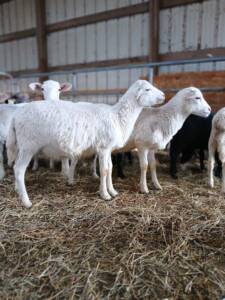 We didn’t know much about sheep at the time, but we learned fast. From our initial 37 acres and five ewes, we’ve grown the farm to more than 70 acres and over 400 ewes. We’ve focused on Katahdin sheep as they’re low-maintenance hair sheep, hardy, and great mothers. They were exactly the right fit for us as beginners and we knew early on we didn’t want to deal with shearing. Today, we’re working to improve the quality of our flock by using only registered rams and aiming for a mix of registered and Katahdin-plus ewes (commercial ewes with registered sires), selecting for the most desirable traits along the way.
Our Management Style
One thing that sets us apart is how we manage our flock. We have been on an accelerated lambing schedule for many years now, but last year we took it a step further by dividing the flock into four groups of about 100 ewes each. Each group follows its own rotation, so we’re lambing every other month — six times a year. It takes a lot of record keeping and organization, but it allows us to provide lamb almost year-round, use our facilities efficiently, and make the most of our time and resources.
We use rotational grazing to keep the pastures healthy and the sheep on fresh forage throughout the growing season. In the winter, they come into the barns and are fed hay and locally sourced grain. With the number of sheep we graze, our acreage can’t support breeding and lambing on pasture every other month too, so each group is bred and lambs indoors where we can control space and feed more efficiently. It’s a lot of shuffling, but it’s a cycle we’re becoming accustomed to, and it seems to work for our market. We now have a large number of sheep to sell as feeders in the spring, lamb to sell around the holidays, and a good amount to sell at auction when the prices are strongest early in the year.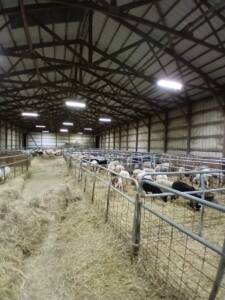
We Appreciate All Our Customers
Over the years, we’ve sold several starter flocks, bred ewes, breeding ewe lambs, and breeding rams helping many producers get started with Katahdins. Many of these new shepherds contact us for more information when they are lambing or have an animal health issue. We enjoy sharing what we’ve learned and often point them to other resources and educational materials to help them succeed. We also share some of our experiences on social media.
Many customers return year after year to buy whole lambs for custom processing or frequently buy our retail cuts. With a food warehouse license and by using a USDA processor, we can sell directly to consumers as well as in local food stores. Since many of our customers are new to lamb, we share some of our favorite lamb recipes — simple, flavorful meals from our own kitchen. Roasted leg of lamb, lamb curry stew, lamb meatballs, slow-cooked shanks, and grilled chops are just a few of the dishes we enjoy and like to pass along to others.
Thankful for Small Miracles
It’s been 15 years since we took that first step with sheep, and we’ve come a long way. We’ve learned a lot (sometimes the hard way), and we’re still learning every day. Our favorite moments are being present during the miracle of a ewe giving birth, watching the little ones when they get the zoomies, and seeing the sheep eagerly rush out on fresh pastures.
Thanks for being part of our story — and for supporting local, small farms like ours.